In This Moment: What Is Our Work as Men?
There are moments in this work that ask more of us. Moments that hold grief and contradiction at the same time. And moments that force us to confront what we would rather keep separate because it feels too complex or overwhelming. This is one of those moments. Across communities, many are processing the allegations connected to César Chávez, a figure long associated with dignity and the fight for farmworkers’ rights. For some, this moment, these revelations, this truthtelling has been shocking. For others, it has been less surprising, but no less painful. And for many, especially those closest to the work and the communities impacted, the grief is layered. Because many things can be true at once.
A person can contribute to movements for justice and still cause harm. A legacy can carry both impact and injury. And communities can feel pride and heartbreak in the same breath. But men, we also have to be clear that our responsibility does not change in the presence of this complexity.
This Is Not Just About One Man
It would be easy to locate this moment in one individual to treat it as an exception and separate it from the larger culture that allows harm to exist. But that would be a mistake. That is like addressing the cough in the cold. Or a symptom that is signaling a much deeper issue. What we are witnessing is not new. It is part of a broader pattern we have seen again and again — men who are deeply committed to justice in one area, while causing harm in another. Men who fight against racism, but do not have an accountable gender analysis. Men who are celebrated as leaders, while women in their communities carry the weight of harm in silence.
Too often, we approach justice as if it can be compartmentalized. But justice does not work that way. If our commitment to justice does not include the experiences of all women, girls, and those who reside in the margins of the margins, it is incomplete.
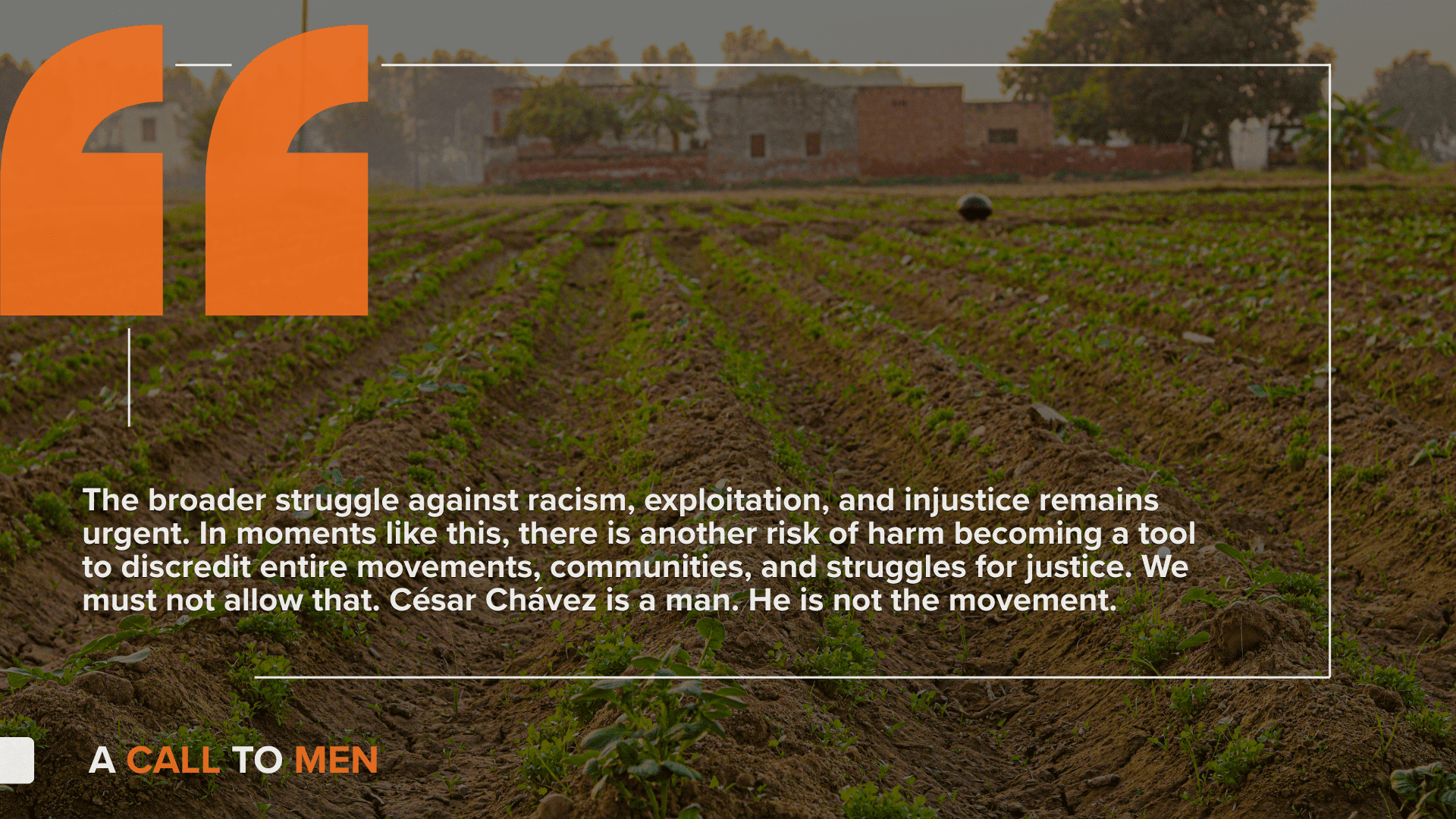
The broader struggle against racism, exploitation, and injustice remains urgent. In moments like this, there is another risk of harm becoming a tool to discredit entire movements, communities, and struggles for justice. We must not allow that. César Chávez is a man. He is not the movement. The fight for farmworkers’ rights, dignity, and fair labor conditions is real and necessary.
We can hold individuals accountable without allowing the integrity of the movement to be undermined. Both are required. Working in solidarity across movements requires that we see our struggles as interconnected. As men, we also carry a responsibility in moments like this to ensure that the work itself is not derailed. Men must be part of the glue that keeps movements grounded in their purpose, especially when trust is broken.
We also want to name something that often goes unsaid.
This moment is heavy. It is heavy for survivors, women in leadership who are once again being asked to carry the burden of speaking up, communities that are navigating both loyalty and truth, those whose own experiences are being resurfaced and triggered, and it is heavy for men who are trying to do this work with integrity through an intersectional lens. We honor these weights. We will not rush past it. Because how we move through this moment matters. We must create spaces for all who have been harmed to be believed, listened to, to heal, and to be in community. Community care and healing are at the core of our collective liberation.
We must also be honest about what is happening in real time. Many men, including men in our own communities, are responding by questioning women, shifting blame, or asking whether women were complicit. This is not the moment to interrogate women. This is the moment to believe survivors.
And this is a moment for men to take leadership with other men to interrupt harmful narratives, challenge the instinct to deflect, deepen our gender analysis, and to build the empathy required to show up differently. We must create spaces where men can be called in, not just called out. We are here to challenge those responses and offer a different way forward.
What Is Our Work as Men?
Moments like this can either move us backward, or push us toward deeper accountability and more honest leadership. At A Call to Men, we remain grounded in what we know to be true. We must believe survivors, center those who have been harmed, and resist the instinct to explain away, minimize, or redirect. We must choose to challenge men to rise to a higher standard. Not just when it is easy. But especially when it is not. Sexual violence is preventable and preventing it requires us to do this work fully. If you are a man asking yourself what to do in this moment, start here.
First, we listen to and believe survivors without defensiveness and conditions. And we must follow their leadership while also growing our responsibility as men to influence other men.
Second, we examine ourselves and ask the hard questions. Where are we doing “good work” in one area, while avoiding accountability in another? Where are we missing a gender analysis in our leadership, our organizations, and our movements? Under what circumstances do we give ourselves a pass? When do we speak up? When do we stay silent? And why? Our actions as men must be in alignment with the truth and experiences of women, girls, and those who reside in the margins.
Third, we educate ourselves. Our job as men is to increase our gender analysis and deepen our efforts to practice and promote healthy masculinity. As men, we must seek alignment with all movements seeking justice for our communities. In other words, this work must be done through an intersectional lens.
Finally, we take responsibility for the culture we help create. This is not women’s work to fix. It is ours. And that responsibility does not begin in public statements. It begins in our relationships and daily choices. This moment is a new urgent invitation for all men to a deeper commitment, practice, learning, and action. Our moment to step up is now.